
Frequently Asked Questions (FAQ)

Frequently Asked Questions:
Can I resistance weld copper? How about projection welding copper?
- you should use some higher resistance electrode to touch your copper part. You could use a Tungsten-copper alloy, like “Elkonite” (trade name), you could use pure Tungsten or molybdenum, or we’ve seen some success with carbon/graphite. Elkonite and Tungsten are most readily available, the others would be experimental. Welding copper with copper won’t work.
- you should clamp one of your parts with the machine in “no weld” (the weld turned off), and see if you’re squishing the projections before you even weld. If so, back the pressure off until you’re not squishing projections, and then back it off a little more.
- unless your customer forbids it, try ditching the weld projections and just trying one weld at a time
- the more common and “better” way to use a resistance welder to join copper is to resistance braze with braze foil between the copper parts. Again, if the customer says you can’t do that, then you can’t. I can’t imagine braze foil working well with weld projections, but you could try a few.
- the best solution would be to ditch the projections, use braze foil, and probably do one weld (one side, in your case?) at a time.
~CK
When I press the foot pedal on my spot welder, sometimes it works and sometimes it doesn’t.
~CK
My spot welder had a major blow out today, now my operators are afraid of the machine.
A “blowout” would happen from one of a few things:
- Excess welding current
- Improper clamping force
- Dirty electrodes or parts
- Welding too close to the edge of a part, or on top of another weld
With the weld control you have, there are numerous redundancies to prevent inconsistent weld current (beyond gross operator error). If the blowout “just happened out of the blue”, it is most likely due to poor clamping force.
The resistance welding process is highly reliant on a good, tight fit between the two electrodes. If there is a poor material stack-up between the electrodes, with any sort of an air gap, you are essentially making a big spark plug.
There are a number of ways you can have poor clamping force:
- Air pressure set too low on the regulator controlling the weld clamping force
- Electrode holders too far apart, allowing the air cylinder to bottom out
- Bent parts that don’t fit tightly together
Another possible cause is dirty electrodes, dirty parts, oils, coatings, oxides, or other contamination. You should be dressing your electrodes daily — in some cases hourly. With aluminum, you may have to dress the electrodes every 5 welds (if there is excess oxide or other contaminants).
Also make sure your welds are not next to an edge, or on/near another weld.
There are other possible causes but these are the most common.
~CK
My spot welder electrodes are getting really hot. I think there’s a problem with the water tubes.
Proper water cooling is one of the key things that make resistance welding possible. You are right to suspect the coolant tubes.
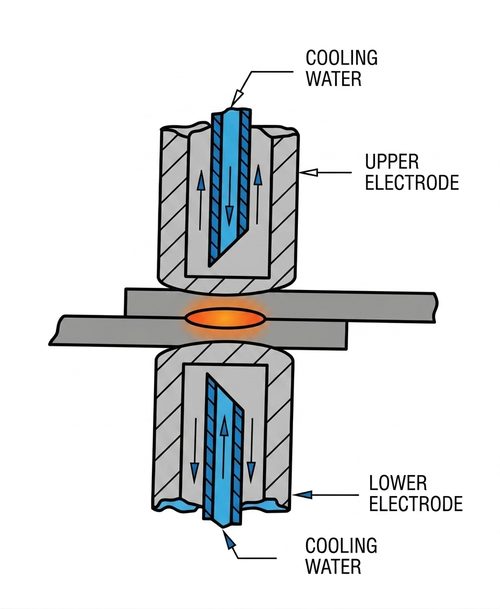
As shown in the diagram, water must flow out through the water tube and the tube must be positioned right up close to the welding surface. This sounds simple, but here are some of the issues we’ve seen in practice:
- Water tubes missing — fresh cold water never reaches the end of the electrode
- Water tubes too short / not close enough to the end of the hole in the electrode
- The water must exit the tube, splash against the electrode, and return around the outside of the tube (as shown in the diagram) — this does not work if plumbed backwards
- Poor water flow & pressure:
- The machine has a water in/out on the side, but inside there is often a manifold that splits the flow
- The manifold can split water between several circuits: controls (SCR/IGBT), transformer/inverter, electrodes, and secondary
- It is possible to have good flow at the main in/out but have a coolant channel completely blocked or getting poor flow
- Get a 5-gallon bucket, remove the hose exiting each electrode holder, and check the flow coming out of each
- Some machines have a ball valve and flow meter on each circuit to ensure equal distribution
Copper starts to discolor when it gets too hot and permanently softens at 900°F / 500°C. Your electrodes should never get above around 120°F — cool enough to touch.
Common fixes include repairing or replacing the water tubes, or in many cases simply replacing the entire electrode holder(s). Some electrode holders are spring-loaded, making it easy to adjust tube length regardless of electrode length. Let us know if you need a source for new electrode holders.
~CK
Can I hire someone to qualify my machine to AWS D17.2?
You can, but you shouldn’t.
Yes, consultants offer this service, and nothing in the standard forbids it. But it’s like paying someone to take your driver’s test. You pass, and then you’re alone on the highway.
AWS D17.2, Specification for Resistance Welding for Aerospace Applications, was written by and for experienced welding engineers. It isn’t light reading. To get started, you need to understand the fundamentals: squeeze force, weld current, weld time, hold time, and electrode maintenance. Qualifying your own welder is a pain, but that hands-on learning is the point. It’s what lets you fix a problem when the welds go bad on a Tuesday afternoon.
Compliance is not a one-time event. For mission-critical and aerospace parts, expect ongoing testing and strict documentation.
Destructive testing is still the fastest and cheapest way to verify a spot weld. You pull coupons apart and inspect the results. Non-destructive testing on spot welds is possible, but it’s tricky and expensive. Coupons and tensile tests aren’t there to annoy you. They are the proof.
If you don’t understand how to set up and adjust the weld, you’ll burn time and scrap material figuring it out later.
~CK
Can SoftTouch catch an upside-down or missing weld nut?
Yes, for square JIS weld nuts. All it takes is a plastic ring.
A JIS square weld nut has weld projections on its four corners. Loaded right side up, the projections face down. The upper electrode lands on the top of the nut, and the top is the narrow side.
Upside down, the projections face up. Now the electrode meets the corners, and the corners are the wide side.
To use this, turn the upper electrode down on a lathe so the tip is narrower. Slide a plastic ring over the narrow tip. The shoulder keeps the ring from riding up. The ring’s bore sits between the two nut sizes, and the ring sticks out just past the electrode face.
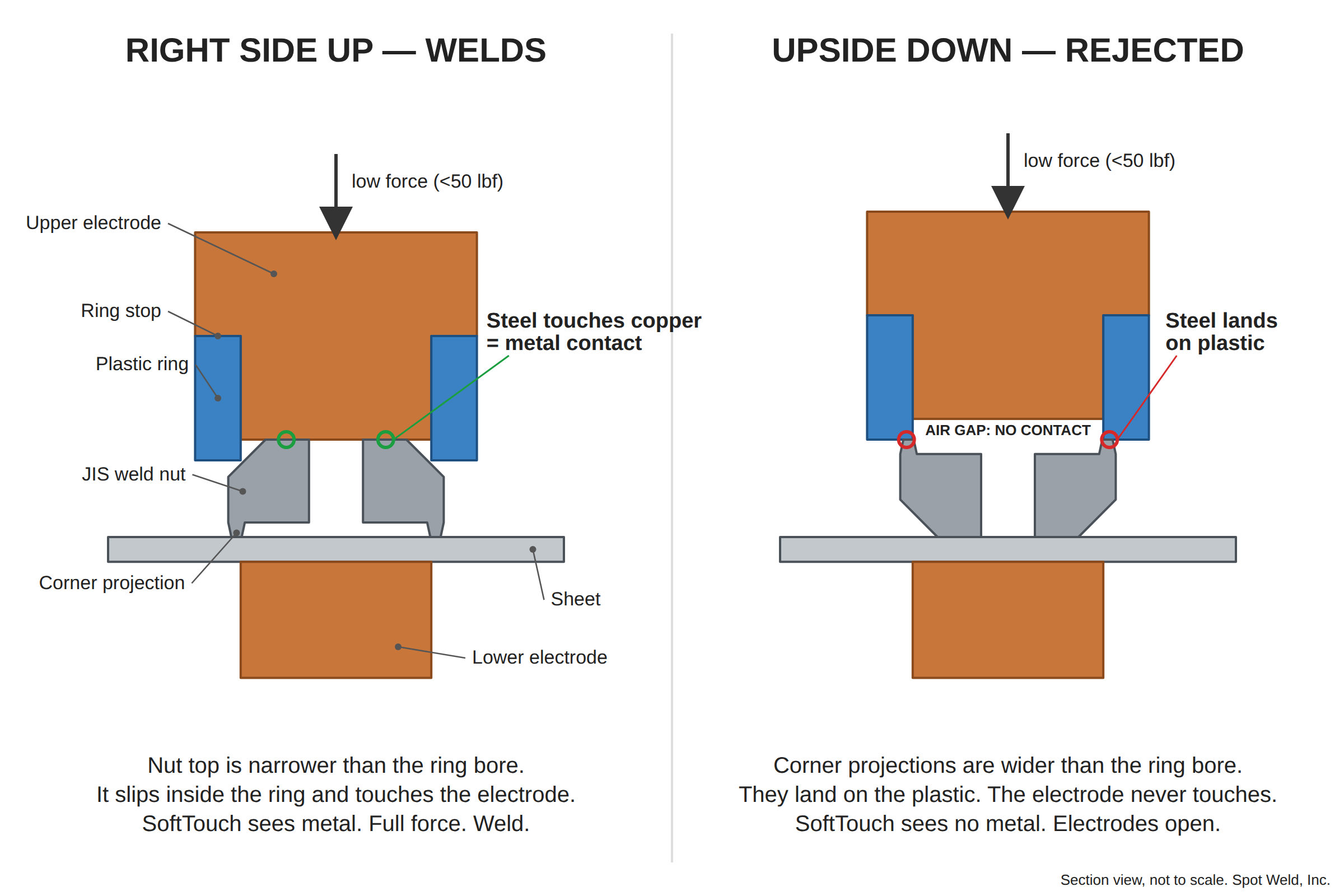
With the nut right side up, the narrow top slips inside the ring and touches the electrode. SoftTouch sees metal. It applies full force, and the machine welds.
With the nut upside down, the wide corners land on the plastic. The electrode never touches the steel. SoftTouch sees no metal, so the electrodes open.
With no nut at all, the ring lands on the bare sheet. Again SoftTouch sees no metal, and the electrodes open.
So one check catches both mistakes. There’s no sensor to wire and no camera to set up. You don’t have to program anything. It checks every nut, every time.
SoftTouch does the work. The ring is a simple part your toolroom can make.
Call us at 800-582-5229 to add SoftTouch to your welder.
~CK